Our editors evaluated 3 Comparisons options against the criteria readers actually weigh up: price, real-world performance, build quality, warranty, and UK availability. Picks lean toward what we'd recommend to a friend buying today, not specs-on-paper winners.
Hands-on contextEditor notes from individual reviews, not press releases.
Live UK pricingRefreshed from Amazon UK twice daily.
No paid placementsAffiliate commission doesn't change what wins.
Finding the Best NZXT Power Supplies: Top Alternatives for 2026 is trickier than it looks. NZXT now sells three closely related ATX 3.1 units at different price points, and the specs overlap enough to cause genuine confusion. You've got the established NZXT C850 Gold ATX 3.1 (2024), the newer NZXT C1000 Gold Core, and the entry-level NZXT C750 Gold Core. All three are 80 Plus Gold certified, all three have zero RPM fan modes, and all three are fully modular. So what actually separates them? Quite a lot, as it turns out. Wattage headroom, GPU connector ratings, capacitor specs, and price-per-watt all differ in ways that genuinely matter depending on your build. This comparison cuts through the marketing and tells you exactly which one to buy.
Side-by-Side Specs: Best NZXT Power Supplies: Top Alternatives for 2026
Wattage and Power Headroom: Which Handles the Biggest Builds?
Winner: NZXT C1000 Gold Core
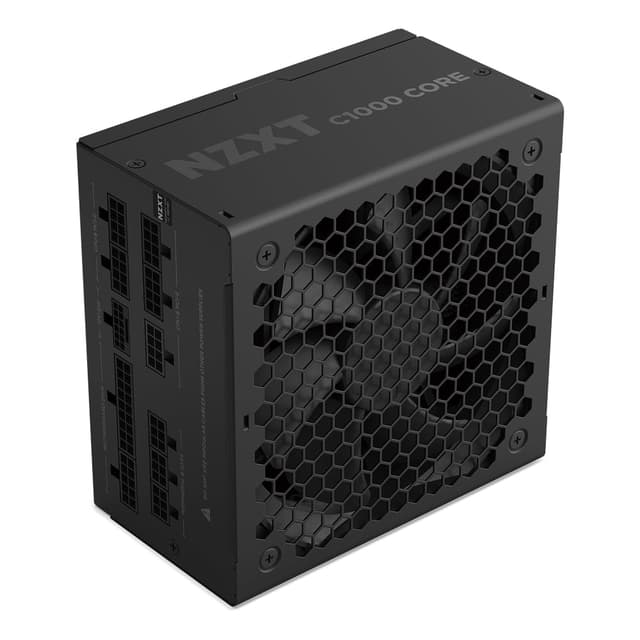
This is the most straightforward comparison in the whole article. The NZXT C1000 Gold Core delivers 1000W. The NZXT C850 Gold ATX 3.1 (2024) delivers 850W. The NZXT C750 Gold Core delivers 750W. That's a 250W spread from top to bottom, which is significant when you're pairing a power-hungry GPU with a high-core-count CPU.
Here's the thing: modern flagship GPUs are genuinely demanding. An RTX 5090, for example, has a TDP of around 575W. Pair that with a Ryzen 9 9950X drawing up to 230W under full load, and you're already pushing 800W before you account for storage, RAM, and fans. The C850 would be cutting it uncomfortably close. The C750 would be flat-out insufficient. The C1000 Gold Core gives you a proper buffer.
For mid-range builds, the picture changes. An RTX 4070 Super at around 220W combined with a Ryzen 7 7700X at 105W puts you well under 400W at full load. In that scenario, the C750 Gold Core is genuinely fine, and the extra wattage of the C850 or C1000 is just money you don't need to spend.
But if you're future-proofing or running a high-end rig, the C1000 Gold Core wins this category cleanly. 150W more than the C850 and 250W more than the C750, and it's actually cheaper than the C850. That's a proper no-brainer for anyone building at the top end.
All three units use the 12V-2x6 connector, which is the current standard for high-power GPU connections and replaces the older 12VHPWR. But the rated usb-c-pd" class="vae-glossary-link" data-term="usb-c-pd">power delivery through that connector varies considerably between these three PSUs, and that difference matters more than most buyers realise.
The NZXT C1000 Gold Core supports up to 600W through its 12V-2x6 connector. That's the full PCIe 5.1 specification, and it means this unit can safely power any current GPU without any derating concerns. The NZXT C750 Gold Core is rated at 300W through its 12V-2x6 connector. That's half the C1000's figure, and while it's fine for GPUs up to around the RTX 4070 Ti tier, it's not suitable for flagship cards.
The NZXT C850 Gold ATX 3.1 (2024) is the odd one out here. NZXT's listing doesn't specify a maximum 12V-2x6 connector rating in the same explicit way the newer Core units do. Given it's an 850W unit, it should handle most high-end GPUs, but the lack of a clear 600W rating is a minor transparency issue compared to the newer Core series.
If you're running or planning to run an RTX 5080, RTX 5090, or any other flagship GPU that draws close to or above 400W, the C1000 Gold Core's 600W connector rating is the one you want. The C750 Gold Core's 300W cap is a genuine limitation for those cards. The C850 sits somewhere in the middle, but without a published connector rating, you're relying on inference rather than specification.
Efficiency Certification: 80 Plus Gold vs Cybenetics Platinum
Draw: C1000 Core and C750 Core edge ahead on paper
All three units carry 80 Plus Gold certification. At 50% load, 80 Plus Gold requires at least 90% efficiency. At 20% and 100% load, the minimum is 87%. In practice, that means if your system draws 400W from the wall, at least 360W is reaching your components. The rest becomes heat. That's a decent standard, and all three units meet it.
But the NZXT C1000 Gold Core and NZXT C750 Gold Core go further. Both carry Cybenetics Platinum ratings. Cybenetics is an independent certification body that runs its own efficiency and noise testing, and its Platinum tier is broadly comparable to 80 Plus Platinum in terms of efficiency thresholds, typically 89 to 92% across the load range. It's a meaningful additional credential, particularly because Cybenetics also tests acoustic performance, which 80 Plus doesn't.
The NZXT C850 Gold ATX 3.1 (2024) doesn't list a Cybenetics rating. That doesn't mean it's inefficient. The C850 uses 100% Japanese capacitors, which are generally associated with better long-term stability and lower ripple. But on paper, the two newer Core units have an extra certification tick that the C850 lacks.
Practically speaking, the real-world efficiency difference between a well-implemented 80 Plus Gold and a Cybenetics Platinum unit is small, often under 2% at typical loads. You won't notice it on your electricity bill unless you're running the system 24/7 at high load. So this is a draw in terms of day-to-day impact, though the Core units do have the stronger certification story on paper.
This is where the NZXT C850 Gold ATX 3.1 (2024) makes its strongest argument. NZXT explicitly markets this unit as using 100% Japanese capacitors. In the PSU world, that's a meaningful claim. Japanese capacitors from manufacturers like Nippon Chemi-Con, Rubycon, and Nichicon are consistently rated higher for longevity and stability than their Taiwanese or Chinese equivalents. They handle heat cycling better, maintain tighter tolerances over time, and are less likely to degrade after years of use.
The NZXT C1000 Gold Core and NZXT C750 Gold Core specify 105°C rated capacitors. That's the temperature rating, not the origin. 105°C is the standard rating for quality PSU capacitors and is perfectly acceptable. But NZXT doesn't explicitly state these are Japanese capacitors, which leaves some ambiguity. They may well be, but the C850's listing is more transparent on this point.
Why does this matter? A PSU is the one component that, if it fails badly, can take other parts with it. Capacitor quality directly affects ripple suppression, which in turn affects the stability of voltages reaching your CPU, GPU, and storage. Over a five to ten year lifespan, the quality of those capacitors becomes increasingly relevant.
For buyers who plan to keep their system for a long time and want the most confidence in component longevity, the C850's explicit Japanese capacitor claim gives it a credibility edge here. It's not a massive practical difference for most users, but it's a real one. The C850 wins this category.
All three units include a zero RPM (or zero fan) mode. In practice, this means the fan stays completely off during light to moderate loads, which covers the majority of everyday PC use: web browsing, video streaming, light gaming, and office work. You'll only hear the fan spin up under sustained heavy load, and even then, NZXT's fans are generally on the quieter side.
The NZXT C850 Gold ATX 3.1 (2024) markets itself specifically as a "Low Noise" unit, which suggests NZXT has paid particular attention to fan curve tuning on this model. Owner feedback on Amazon broadly supports this, with users noting the fan rarely becomes audible even during gaming sessions.
The NZXT C1000 Gold Core and NZXT C750 Gold Core both carry Cybenetics ratings, which as mentioned earlier include acoustic testing. A Cybenetics Platinum rating implies the unit meets specific noise thresholds across load levels, so there's independent verification of the acoustic performance here that the C850 lacks.
In real-world terms, all three will be inaudible during typical use. The C850 has the "Low Noise" marketing and owner validation. The Core units have Cybenetics acoustic certification. Neither has a clear practical advantage for the average user, so this is a draw. If you're building a near-silent workstation and want the most rigorous acoustic credentials, the Core units' Cybenetics rating is a slight edge. For gaming builds, it genuinely won't matter.
Draw: All three are fully modular with similar build quality
All three units are fully modular. That means every cable, including the 24-pin ATX and CPU power cables, can be removed when not in use. For cable management, this is the gold standard. You only route the cables you actually need, which keeps your case tidy and improves airflow. Semi-modular units, which leave the main cables permanently attached, are a step down in this regard.
Physically, all three share NZXT's characteristic clean black aesthetic. No RGB, no aggressive styling. They'll sit quietly behind your motherboard tray and get on with the job. The build quality across the NZXT C-series line is generally well regarded, with solid metal housings and quality connectors.
The NZXT C850 Gold ATX 3.1 (2024) is the older design here, launched in 2024. The C1000 Gold Core and C750 Gold Core are newer additions to the lineup, branded as the "Core" series. The Core branding appears to represent NZXT's updated platform, though the physical differences in build quality between the C850 and the Core units are not dramatically apparent from available specs and owner feedback.
One practical note: fully modular PSUs do require you to use the included cables rather than mixing cables from other units. NZXT's cable ecosystem is well documented, and replacement cables are available if needed. This applies equally to all three units. It's a draw across the board here.
Value for Money: Price Per Watt and What You Actually Get
Winner: NZXT C1000 Gold Core
This is where the comparison gets genuinely interesting, and where the NZXT C1000 Gold Core does something unusual: it costs less than the NZXT C850 Gold ATX 3.1 (2024) while delivering more wattage and carrying an additional Cybenetics Platinum certification. That's a fairly remarkable value proposition.
At around £82.15, the C1000 Gold Core works out to roughly £0.12 per watt. The C850 at around £136.99 works out to approximately £0.16 per watt. That's a 25% worse price-per-watt ratio for the C850, and you're getting fewer watts. The C750 Gold Core at around £99.99 comes in at about £0.13 per watt, which is competitive but not as sharp as the C1000.
So why would anyone buy the C850? A few reasons. First, the Japanese capacitor claim is explicit and reassuring for long-term reliability. Second, the C850 has been on the market longer and has a more established owner review base, which gives you more confidence in real-world performance. Third, for some buyers, 850W is genuinely the right wattage for their build, and they don't want to pay for 1000W they'll never use.
But purely on value, the C1000 Gold Core is the winner. More watts, Cybenetics Platinum, a 600W 12V-2x6 connector, and a lower price than the C850. The C750 Gold Core is the right call if 750W genuinely covers your needs and you want to save another £20. For anyone building at the high end, though, the C1000 Core is the obvious choice on value grounds.
For further context on how these units compare to the broader PSU market, TechPowerUp's PSU reviews are an excellent reference point for understanding efficiency curves and ripple performance across load ranges.
ATX 3.1 is the current Intel power supply specification, and all three units here comply with it. The key improvement ATX 3.1 brings over ATX 3.0 is better handling of transient power excursions, those sudden spikes in power demand that modern GPUs produce during rapid load changes. Under the ATX 3.1 spec, a PSU must handle transient loads of up to 200% of its rated power for short durations without triggering overcurrent protection.
This matters because older PSUs, particularly those built to ATX 2.x standards, would sometimes shut down or throttle when paired with GPUs like the RTX 4090 or RTX 5090 due to these transient spikes. ATX 3.1 compliance means all three of these NZXT units are designed to handle that behaviour gracefully.
The NZXT C1000 Gold Core and NZXT C750 Gold Core are also listed as PCIe 5.1 compatible, which is the connector standard that accompanies ATX 3.1. The NZXT C850 Gold ATX 3.1 (2024) is ATX 3.1 compliant and uses the 12V-2x6 connector, though its listing doesn't explicitly call out PCIe 5.1 in the same way. In practical terms, the connector is the same physical standard.
For future-proofing, all three are on solid ground. You won't need to replace any of these PSUs simply because a new GPU generation arrives, assuming the wattage remains appropriate. It's a draw across the board on ATX compliance.
NZXT's official product pages provide full specification sheets for each unit if you want to verify compatibility details before purchasing. You can find them at nzxt.com/category/power-supplies.
You want explicit 100% Japanese capacitor quality for long-term reliability and peace of mind.
Your build centres on a high-end GPU like an RTX 4080 or RX 7900 XTX, where 850W is the right wattage without overspending on 1000W.
You prefer a unit with a longer track record and more established owner reviews behind it.
You're not running a flagship GPU that needs a confirmed 600W 12V-2x6 connector rating.
Buy the NZXT C1000 Gold Core If:
You're building around a flagship GPU like an RTX 5090 or RTX 5080 and need the 600W 12V-2x6 connector rating and 1000W headroom.
You want the best value per watt in this trio, as the C1000 Core undercuts the C850 despite delivering 150W more.
Cybenetics Platinum certification matters to you for efficiency and acoustic verification.
You're future-proofing a high-end build and want maximum power headroom for the next GPU generation.
Buy the NZXT C750 Gold Core If:
Your build uses a mid-range GPU like an RTX 4070, RTX 4070 Super, or RX 7800 XT, where 750W is genuinely sufficient.
Budget is a priority and you want Cybenetics Platinum credentials without spending over £100.
You're building a compact or secondary system where maximum wattage headroom isn't a concern.
You understand the 300W 12V-2x6 connector limit and your GPU doesn't exceed it.
How We Researched These Units
We don't claim to have run these PSUs through a load tester or oscilloscope in a lab. What we have done is pull together every available specification from NZXT's official product pages, cross-referenced with Amazon UK listings and owner feedback. We've looked at efficiency certification documentation from both 80 Plus and Cybenetics, reviewed how the 12V-2x6 connector ratings compare to current GPU TDP figures, and assessed price-per-watt ratios at current UK retail prices. Owner reviews on Amazon UK have been read and weighted for recurring themes around noise, reliability, and build quality. Where specs are ambiguous or absent, we've said so rather than guessing. The goal is to give you an honest picture of what each unit actually offers, not a sanitised version of the marketing copy.
Final Verdict: Best NZXT Power Supplies: Top Alternatives for 2026
Across this comparison, the NZXT C1000 Gold Core is the standout pick for most buyers. It wins on wattage, GPU connector rating, and value for money, and it does so while costing less than the older C850. That's a genuinely unusual combination. The NZXT C850 Gold ATX 3.1 (2024) earns its place as the best overall pick for buyers who specifically want the reassurance of 100% Japanese capacitors and a well-established reliability record, particularly for mid-to-high-end builds where 850W is the right fit. And the NZXT C750 Gold Core is a proper budget win: Cybenetics Platinum, fully modular, and under £100, making it the sensible choice for mid-range builds that don't need flagship GPU power delivery. When it comes to the Best NZXT Power Supplies: Top Alternatives for 2026, the C1000 Gold Core takes the overall crown on value and capability, the C850 wins on long-term reliability credentials, and the C750 is the one to buy if your wallet is the deciding factor.
Frequently Asked Questions
The RTX 4070 (200W) plus Ryzen 7 7700X (105W TDP) totals approximately 305W at peak gaming load. Adding 30-40% headroom suggests 550-650W actual capacity. We recommend the NZXT E650 or MSI MPG A650GF for comfortable overhead without excessive cost.
Fully modular supplies (NZXT E650, Seasonic Focus GX-650, Corsair RM850x) offer maximum flexibility by letting you connect only required cables, improving airflow and reducing clutter. Semi-modular units (MSI MPG A650GF) fix motherboard and CPU connectors permanently, simplifying installation and remaining adequate for most cases. Choose based on your case's cable management features and personal preference.
80+ Gold units lose 10-15% input power as heat versus 15-20% for Bronze ratings. For typical 12-16 hour daily usage, annual electricity savings rarely exceed £20-30, making Gold-rated PSUs sensible value. However, if your electricity rates exceed 25p/kWh or you plan 24/7 operation, the efficiency margin becomes more meaningful.
NZXT E-series employ passive operation below 50% load, where internal temperatures remain cool enough without fan rotation. Corsair and other designs use thermistor-controlled fans that activate continuously even at low loads. Passive designs suit gaming, whilst active designs suit content creation with sustained higher power draws.
Buying 100-150W extra capacity (£15-30 premium) provides future-proofing against next-generation GPU upgrades and prevents power-limit throttling when pairing extreme CPUs with high-end GPUs. However, oversizing beyond 850W for mid-range builds wastes money on wattage you will never use, making the MSI MPG A650GF or NZXT E650 ideal for present-day mid-tier systems.