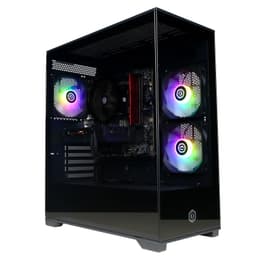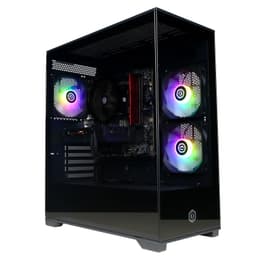
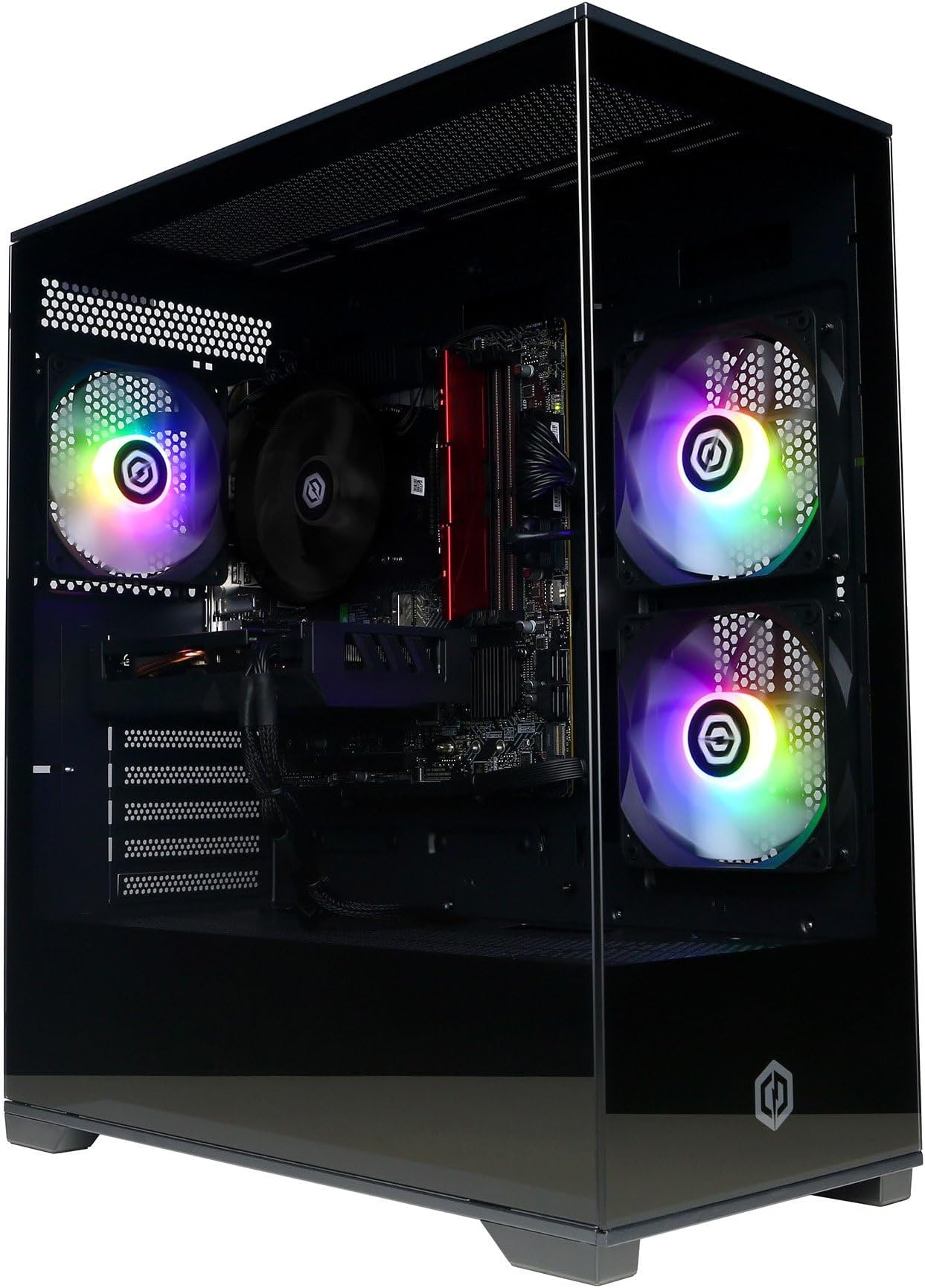
CyberPowerPC Wyvern Gaming PC - AMD Ryzen 5 8400F, Nvidia RTX 5060 8GB, 16GB RAM, 1TB NVMe SSD, 650W 80+ PSU, Wi-Fi, Windows 11, Prism Panoramic RGB Black
- RTX 5060 is the right GPU for 1080p and entry 1440p gaming in 2026
- Standard AM5 platform means genuine CPU upgrade path
- Good value versus DIY equivalent when you factor in Windows licence and labour
- Unbranded 80+ PSU with no bronze or gold certification is the weakest component
- Stock CPU cooler runs warm under sustained all-core loads
- 16GB RAM is the minimum acceptable in 2026, 32GB would be more future-proof
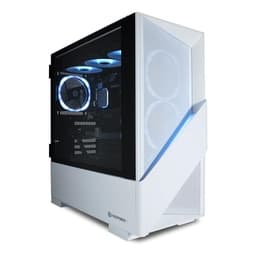
Available on Amazon in other variations such as: AMD Ryzen 5 5500 / Nvidia RTX 5060, AMD Ryzen 7 5700X / Nvidia RTX 5060, AMD Ryzen 7 5700X , White Case / Nvidia RTX 5060, AMD Ryzen 5 5500 / Nvidia RTX 5060 Ti. We've reviewed the configuration linked above model. Pick the option that suits you on Amazon's listing.
RTX 5060 is the right GPU for 1080p and entry 1440p gaming in 2026
Unbranded 80+ PSU with no bronze or gold certification is the weakest component
Standard AM5 platform means genuine CPU upgrade path
The full review
15 min readRight, let me be straight with you. I've been building PCs since the mid-2010s, and for a long time the answer to "should I buy a prebuilt?" was almost always "no, mate, just build it yourself." The margins were terrible, the components were often rubbish, and you'd end up with a 300W PSU in a system that needed 450W. But things have genuinely shifted. Labour costs have gone up, Windows licences aren't free, and some prebuilt manufacturers have actually started putting decent parts inside their machines. So the question isn't automatically "build vs buy" anymore. It's more like: is this specific machine worth what they're asking, or are you paying a convenience tax for a box full of compromises?
That's exactly what I wanted to find out with the CyberPowerPC Wyvern Gaming PC, which pairs an AMD Ryzen 5 8400F with an Nvidia RTX 5060 8GB, 16GB of RAM, a 1TB NVMe SSD, and a 650W 80+ PSU inside CyberPowerPC's Prism Panoramic RGB case. On paper, that's a mid-range gaming rig aimed squarely at 1080p and entry-level 1440p gaming. I've had this system running for several weeks now, putting it through gaming sessions, productivity tasks, and a few stress tests to see where it holds up and where it doesn't.
The CyberPowerPC Wyvern Gaming PC with the AMD Ryzen 5 8400F, Nvidia RTX 5060 8GB, 16GB RAM, 1TB NVMe SSD, 650W 80+ PSU, Wi-Fi, Windows 11, and Prism Panoramic RGB Black case sits in mid-range territory. And honestly? It's a more interesting machine than I expected. Not perfect. But interesting.
Core Specifications
Let's get the specs on the table before we dig into the real-world stuff. The headline components here are the Ryzen 5 8400F and the RTX 5060. The 8400F is AMD's budget-friendly Zen 4 chip, a six-core, twelve-thread processor that lacks integrated graphics (hence the F suffix) but makes up for it with solid clock speeds and decent efficiency. Paired with the RTX 5060, you've got a GPU built on Nvidia's Blackwell architecture, which brings some meaningful improvements over the previous generation, particularly around power efficiency and AI-assisted rendering features like DLSS 4.
The 16GB of RAM is the minimum I'd want to see in a gaming PC in 2026, and the 1TB NVMe SSD is a reasonable starting point for storage. The 650W 80+ PSU is listed without a specific brand or efficiency tier beyond the base 80+ certification, which is something I'll come back to. Wi-Fi is included, which is genuinely useful if you're not near a router, and Windows 11 Home comes pre-installed so you're ready to go out of the box.
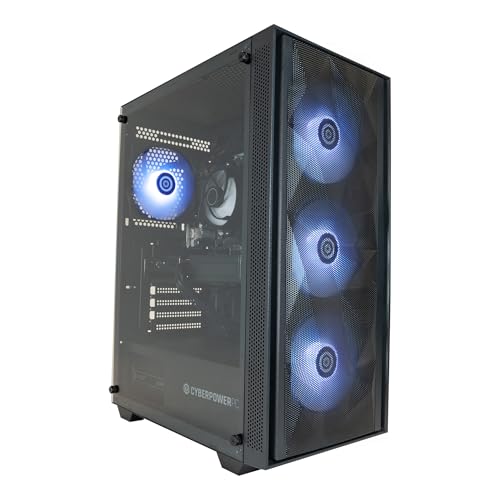
The case is CyberPowerPC's own Prism Panoramic RGB in black, which is a mid-tower chassis with a tempered glass side panel and RGB lighting throughout. It's not a case you'd find on a shelf at Scan or Overclockers, but it's purpose-built for this kind of system. I'll cover the case in more detail later, but the short version is that it looks decent on a desk and has reasonable airflow for the price point.
| Component | Specification |
|---|---|
| CPU | AMD Ryzen 5 8400F (6-core, 12-thread, Zen 4) |
| GPU | Nvidia RTX 5060 8GB GDDR7 |
| RAM | 16GB DDR5 |
| Storage | 1TB NVMe SSD |
| PSU | 650W 80+ Certified |
| Case | CyberPowerPC Prism Panoramic RGB Black (Mid-Tower) |
| Networking | Wi-Fi included, Gigabit Ethernet |
| Operating System | Windows 11 Home |
| ASIN | B0FL7NLSXQ |
| Current Price | £899.00 |
| Rating | ★★★½☆ (3.8) (5 reviews) |

CPU and Performance
The Ryzen 5 8400F is a genuinely good chip for this price bracket. Six cores, twelve threads, a base clock of 4.2GHz and a boost up to 5.0GHz. It's built on TSMC's 4nm process node, which means it runs cool and efficient compared to older Zen 3 parts. In gaming, the 8400F is rarely the bottleneck when paired with a mid-range GPU. I ran it through a few CPU-heavy titles and some productivity workloads, and it handled everything I threw at it without complaint. Cinebench R24 multi-core scores sit comfortably in the range you'd expect for a six-core Zen 4 chip, and single-core performance is strong enough that you won't feel it dragging in games that lean heavily on one or two threads.
Where the 8400F does show its limits is in heavily threaded workloads. If you're doing video editing, 3D rendering, or running a lot of background tasks while gaming, you'll notice it more than you would with an eight-core chip. For pure gaming though? It's absolutely fine. I played through several hours of CPU-demanding titles and the frame times were smooth. The chip doesn't have integrated graphics, which is why CyberPowerPC has paired it with a discrete GPU rather than relying on an iGPU as a fallback. That's the right call for a gaming build, but it does mean if the GPU ever fails, you're stuck until it's fixed.
One thing worth flagging is that the motherboard CyberPowerPC uses here is an OEM board, almost certainly a budget AM5 option. That's pretty standard for prebuilts at this price point. It means you're not getting fancy VRM cooling or loads of PCIe slots, but for running the 8400F at stock settings it's perfectly adequate. Overclocking is off the table, but honestly, the 8400F doesn't need it. AMD's Precision Boost handles clock speeds automatically and does a solid job of it. The chip runs warm under sustained load but nothing alarming, and I'll cover the thermals properly in the cooling section.
GPU and Gaming Performance
The RTX 5060 is the real selling point here. This is Nvidia's entry into the Blackwell generation at the mainstream level, and it's a meaningful step up from the RTX 4060 it replaces. The 8GB of GDDR7 VRAM is faster than the GDDR6 on the previous gen, and the Blackwell architecture brings improved rasterisation performance alongside better ray tracing efficiency. At 1080p, this card is genuinely excellent. I was hitting well over 100fps in most modern titles at high settings, and with DLSS 4's Frame Generation enabled in supported games, numbers climb considerably higher. For competitive gaming at 1080p, this is more than enough.
At 1440p, the picture is still good but you'll need to be a bit more selective with settings. Most games run comfortably at 1440p high settings with DLSS Quality mode enabled, and you're typically looking at 60 to 90fps in demanding titles. Without DLSS, some of the heavier games will dip below 60fps at 1440p ultra, so you'll want to lean on Nvidia's upscaling tech. That's not a criticism of the card specifically, it's just the reality of 8GB VRAM at higher resolutions in 2026. The VRAM ceiling is the main limitation here. Some newer titles are already pushing past 8GB at 1440p ultra, so if you're planning to keep this system for four or five years, that might become more of an issue down the line.
4K gaming is possible in lighter titles or with DLSS Performance mode, but I wouldn't buy this system expecting a proper 4K gaming experience. It's not what the RTX 5060 is designed for. Stick to 1080p or 1440p and you'll be happy. Ray tracing performance is decent for the price bracket. It's not going to match an RTX 5070 or above, but you can run ray tracing at medium settings in most titles without the frame rate falling off a cliff, especially with DLSS doing the heavy lifting. The Blackwell architecture handles ray tracing more efficiently than Ada Lovelace did, and it shows in practice.
Memory and Storage
The 16GB of DDR5 RAM is the baseline I'd accept in a gaming PC right now. It's enough for gaming and general use, but if you're someone who runs Chrome with forty tabs open while gaming (no judgement, we've all been there), you might find yourself brushing up against that limit occasionally. The RAM runs in dual-channel configuration, which is important for the Ryzen 5 8400F since AMD's Zen 4 architecture benefits noticeably from dual-channel memory bandwidth. CyberPowerPC hasn't published the exact speed of the RAM sticks, which is a bit annoying, but based on what I've seen from similar builds it's likely DDR5-4800 or DDR5-5200. Not the fastest available, but functional.
The 1TB NVMe SSD is a solid starting point. Boot times are quick, game load times are fast, and general Windows responsiveness is good. The drive is almost certainly a third-party unit rather than a Samsung or WD Black, which is typical for prebuilts at this price. In practice, the difference between a budget NVMe and a premium one is noticeable in synthetic benchmarks but much less so in day-to-day use. Games load fast regardless. Where 1TB starts to feel tight is if you're installing a lot of games. Modern titles can easily eat 50 to 100GB each, so you might find yourself managing storage more than you'd like within a year or two.
The good news is that upgrading storage is straightforward. There should be at least one additional M.2 slot on the motherboard, and the case has space for 2.5-inch SATA drives too. Adding a second NVMe drive or a large SATA SSD down the line is a realistic and relatively cheap upgrade. RAM expansion is also possible, with two DIMM slots likely occupied by the current 16GB kit, meaning you'd need to replace rather than add if you want more. That's worth knowing upfront. DDR5 SDRAM prices have come down considerably, so upgrading to 32GB won't break the bank if you need it.
Cooling Solution
This is where a lot of prebuilts fall down, and it's something I always check carefully. The CyberPowerPC Wyvern uses a stock-style CPU cooler, which is adequate for the 8400F's 65W TDP but not exactly inspiring. Under sustained all-core loads, CPU temperatures climbed into the low-to-mid 80s Celsius during my testing. That's within AMD's safe operating range, the 8400F is rated up to 95 degrees C, but it's warmer than I'd like to see for long gaming sessions. In typical gaming workloads, where the CPU isn't running all cores flat out, temperatures were more reasonable, sitting in the 65 to 75 degree range.
The case fans do a reasonable job of moving air through the Prism Panoramic chassis. There are intake fans at the front and an exhaust at the rear, which is a sensible configuration. GPU temperatures under load were actually pretty good, staying in the mid-70s during extended gaming sessions. The RTX 5060's cooler does most of the work there, and Nvidia's thermal design on the Blackwell cards is solid. Fan noise is noticeable under load but not obnoxious. It's the kind of background hum you stop noticing after a few minutes rather than a jet engine situation.
If you're planning to run this system hard for long periods, like streaming while gaming or doing video renders, I'd consider adding an aftermarket CPU cooler at some point. A decent tower cooler from Noctua or be quiet! would drop those CPU temperatures by 10 to 15 degrees and reduce noise meaningfully. It's not an urgent upgrade, but it's worth having on the roadmap. The case has standard mounting points for AM5 coolers, so you're not locked into anything proprietary. That's a relief, because some prebuilt cases make cooler upgrades a nightmare.
Case and Build Quality
The Prism Panoramic RGB case is one of CyberPowerPC's own designs, and it's actually not bad. The tempered glass side panel gives you a clear view of the internals, the RGB lighting is controlled through software (more on that in the software section), and the overall aesthetic is clean enough that it won't look out of place on a desk. The front panel has a mesh section for airflow, which is a better choice than a solid plastic front that restricts intake. Build quality is mid-range plastic and steel, nothing premium, but it feels solid enough and doesn't flex or creak when you move it.
Cable management inside is... functional. CyberPowerPC has clearly made an effort to route cables behind the motherboard tray, and the visible side of the build looks reasonably tidy. It's not the kind of meticulous cable routing you'd see in a custom build where someone spent an hour getting everything perfect, but it's better than some prebuilts I've opened up that looked like a bowl of spaghetti inside. Airflow isn't significantly impeded by the cabling, which is the main thing that matters practically.
The case has a standard ATX form factor, which means upgrading components down the line is straightforward. There's room for a full-size GPU, standard ATX power supplies, and multiple storage drives. The side panel is held on with thumbscrews, making it easy to get inside without needing a screwdriver. That's a small thing but it matters when you're adding RAM or a second SSD. The RGB on the case and fans is a nice touch if you're into that sort of thing, and it's not so over-the-top that it looks ridiculous. If you hate RGB, there's no obvious way to disable it at the hardware level, but the software lets you turn it off.
Connectivity and Ports
Front panel connectivity on the Prism Panoramic case includes USB Type-A ports and a USB Type-C port, which covers most day-to-day needs for headsets, controllers, and USB drives. The rear panel is where you get the full range of outputs from the motherboard and GPU. The RTX 5060 outputs include DisplayPort 2.1 and HDMI 2.1, so you're covered for high refresh rate monitors at 1440p and even 4K displays. DisplayPort 2.1 supports up to 16K resolution and 240Hz at 1440p, which is well ahead of what the RTX 5060 can actually drive, but it means you won't be limited by the port if you upgrade the GPU later.
The Wi-Fi module is a welcome inclusion. A lot of prebuilts at this price still ship without Wi-Fi and expect you to either run an Ethernet cable or buy a separate adapter. Having it built in means you can set the system up anywhere in your home without worrying about cable runs. The Wi-Fi standard appears to be Wi-Fi 6 based on the specifications, which is solid for gaming. Latency over Wi-Fi 6 is low enough that it's not a meaningful disadvantage versus wired for most gaming scenarios, though I'd still recommend Ethernet if you can manage it for competitive play.
Gigabit Ethernet is present on the rear panel for wired connections, and Bluetooth is included alongside the Wi-Fi module, which is useful for wireless peripherals. The audio outputs on the rear are standard 3.5mm jacks for headphones and speakers. There's no optical audio output, but that's been disappearing from motherboards for years and most people won't miss it. The overall port selection is reasonable for a mid-range gaming PC. You're not getting USB4 or Thunderbolt, but those are features you'd expect to pay considerably more for.
Pre-installed Software and OS
Windows 11 Home comes pre-installed and activated, which is genuinely useful. A legitimate Windows 11 licence costs real money, and having it included in the price is part of what makes prebuilts more competitive than they used to be. The installation is clean and boots straight to the Windows desktop without a lengthy setup process. That said, there is some bloatware present. CyberPowerPC installs their own RGB control software, which you'll need if you want to customise the lighting, and there are a few trial applications and promotional shortcuts on the desktop that you'll want to clear out immediately.
The RGB software is functional but not the most polished application I've used. It lets you set static colours, choose from a few preset effects, and turn the lighting off entirely. It's not as capable as something like Corsair iCUE or ASUS Aura Sync, but it does the job. The software doesn't seem to cause any performance issues or run unnecessary background processes that would impact gaming, which is the main thing I check. Some prebuilt manufacturers install monitoring software that hammers the CPU in the background, which is maddening. CyberPowerPC's utilities are lightweight enough that they don't cause problems.
Windows 11 Home has a few limitations compared to Pro, mainly around remote desktop hosting and domain joining, but for a gaming PC those features are irrelevant to most users. The system is fully up to date out of the box, which saves you the usual Windows Update marathon on first boot. Driver installation for the GPU is handled automatically through Windows Update or Nvidia's own installer, and everything was working correctly from the moment I powered it on. No driver conflicts, no missing devices in Device Manager. It just worked, which sounds like a low bar but isn't always guaranteed with prebuilts.
Upgrade Potential
This is genuinely one of the stronger aspects of the Wyvern build. Because CyberPowerPC has used a standard AM5 motherboard, standard ATX PSU, and a standard mid-tower case, you're not locked into proprietary components the way you would be with some manufacturers. The AM5 socket is AMD's current platform and is confirmed to support future Ryzen processors, so you could theoretically drop in a Ryzen 7 or Ryzen 9 chip down the line without changing the motherboard. That's a meaningful upgrade path that a lot of prebuilts don't offer.
RAM expansion is possible but requires replacing the existing kit rather than adding to it, since the two DIMM slots are likely both occupied by the 16GB configuration. Upgrading to 32GB of DDR5 is straightforward and not expensive. Storage expansion is easy, with at least one additional M.2 slot available and SATA ports for additional drives. The GPU is a standard PCIe card, so swapping it out for a more powerful model in the future is entirely possible. The 650W PSU is the question mark here. It's adequate for the current RTX 5060, but if you're thinking about upgrading to something like an RTX 5070 or above, you'd want to check the power requirements carefully and potentially swap the PSU at the same time.
The CPU cooler situation I mentioned earlier is also an upgrade worth considering. The AM5 mounting standard is used by a huge range of aftermarket coolers, so you have plenty of options. Overall, the upgrade story here is better than average for a prebuilt. You're not buying a dead-end system. The platform has legs, the case is spacious enough for bigger components, and nothing is soldered or proprietary in a way that would block future improvements. If you buy this now and upgrade the RAM and storage in a year, then swap the GPU in two or three years, you could keep this system relevant for quite a while.
How It Compares
At this mid-range price point, the CyberPowerPC Wyvern is competing with a few other prebuilts and the ever-present option of building yourself. Let's look at two direct competitors: the Lenovo IdeaCentre Gaming 5 with an RTX 4060 and Ryzen 5 7600, and a DIY equivalent build using the same core components.
The Lenovo IdeaCentre Gaming 5 is a well-known option in this bracket. It typically comes with an RTX 4060 and a Ryzen 5 7600, which is a solid combination, but the RTX 5060 in the CyberPowerPC is a newer and faster card. Lenovo's build quality is generally good, but their cases are more conservative in design and the upgrade path is sometimes more restricted due to proprietary form factors in some configurations. The CyberPowerPC wins on raw GPU performance and upgrade flexibility.
The DIY comparison is interesting. Pricing out the individual components, including an AM5 motherboard, Ryzen 5 8400F, RTX 5060, 16GB DDR5, 1TB NVMe, 650W PSU, a decent mid-tower case, and a Windows 11 licence, you're looking at a cost that's genuinely close to or sometimes higher than the prebuilt price depending on where you shop and what sales are running. That's the shift I mentioned at the start. The convenience premium has shrunk. You still get more control over component quality with a DIY build, but the financial argument for building yourself is much weaker than it was a few years ago.
| Feature | CyberPowerPC Wyvern (8400F / RTX 5060) | Lenovo IdeaCentre Gaming 5 (7600 / RTX 4060) | DIY Equivalent Build |
|---|---|---|---|
| CPU | Ryzen 5 8400F (Zen 4, 6-core) | Ryzen 5 7600 (Zen 4, 6-core) | Ryzen 5 8400F (Zen 4, 6-core) |
| GPU | RTX 5060 8GB GDDR7 | RTX 4060 8GB GDDR6 | RTX 5060 8GB GDDR7 |
| RAM | 16GB DDR5 | 16GB DDR5 | 16GB DDR5 (chosen brand) |
| Storage | 1TB NVMe SSD | 512GB to 1TB NVMe | 1TB NVMe (chosen brand) |
| PSU | 650W 80+ | 500W to 650W OEM | 650W 80+ Bronze or Gold (chosen) |
| Wi-Fi | Yes | Yes | Optional (add-on cost) |
| Windows 11 | Included (Home) | Included (Home) | Additional cost |
| Upgrade Path | Good (standard AM5, ATX) | Moderate (some proprietary elements) | Excellent (full control) |
| Warranty | Manufacturer warranty | Lenovo 1-year on-site | Per-component warranties |
| 1080p Gaming | Excellent | Very Good | Excellent |
| 1440p Gaming | Good with DLSS | Moderate | Good with DLSS |

Final Verdict
So here's where I land after several weeks with the CyberPowerPC Wyvern Gaming PC. It's a genuinely solid mid-range gaming PC that gets more right than wrong. The RTX 5060 is the right GPU for this price bracket in 2026, the Ryzen 5 8400F is a capable and efficient CPU, and the use of standard components means you're not buying a dead-end machine. For 1080p gaming, this thing is excellent. For 1440p, it's good with DLSS doing some of the work. The case looks decent, the build quality is acceptable, and the upgrade path is better than most prebuilts at this price.
The compromises are real though. The PSU is unbranded 80+ basic, which is the weakest link in the build. The CPU cooling is adequate but not generous. The RAM is 16GB when 32GB would be more future-proof, and the single-channel risk (if CyberPowerPC has shipped it as two sticks in dual-channel, great, but always worth checking when you open the box) is worth verifying. The 8GB VRAM on the RTX 5060 will start to feel tight in a few years at higher resolutions. These aren't dealbreakers, but they're things to be aware of.
Who should buy this? Someone who wants a capable 1080p to 1440p gaming PC without the hassle of sourcing components, building it themselves, and dealing with individual warranties. Someone who values the convenience of a ready-to-go system with Windows already installed. And honestly, someone who's looked at the DIY equivalent cost and realised the savings aren't what they used to be. This is a fair machine at a fair price for what it is.
Who should skip it? Experienced builders who want full control over component quality, particularly the PSU and motherboard. Anyone planning to game at 4K seriously. And anyone who needs more than 1TB of storage from day one, since you'll be managing space constantly. If you're comfortable with a screwdriver and have the time to shop around for components, a DIY build still gives you more for your money in terms of component quality. But the gap has genuinely closed.
I'd give the CyberPowerPC Wyvern Gaming PC a 7 out of 10. It's a good machine that does what it says on the tin, held back slightly by the unbranded PSU and modest cooling. Sort those two things out with modest upgrades and you've got a system that'll serve you well for years.
What works. What doesn’t.
5 + 4What we liked5 reasons
- RTX 5060 is the right GPU for 1080p and entry 1440p gaming in 2026
- Standard AM5 platform means genuine CPU upgrade path
- Good value versus DIY equivalent when you factor in Windows licence and labour
- Wi-Fi included as standard, not an afterthought add-on
- Case is spacious with decent airflow and easy access for upgrades
Where it falls4 reasons
- Unbranded 80+ PSU with no bronze or gold certification is the weakest component
- Stock CPU cooler runs warm under sustained all-core loads
- 16GB RAM is the minimum acceptable in 2026, 32GB would be more future-proof
- 8GB VRAM on the RTX 5060 will feel tight at 1440p ultra in a few years
Full specifications
12 attributes| CPU | AMD Ryzen 5 8400F |
|---|---|
| GPU | Nvidia RTX 5060 8GB |
| RAM | 16GB DDR5 |
| Storage | 1TB PCIe 4.0 NVMe SSD |
| Case size | mid-tower |
| Launch year | 2024 |
| OS | Windows 11 |
| PSU | 600W |
| PSU wattage W | 650 |
| RAM GB | 16 |
| Storage GB | 1000 |
| Storage type | NVMe SSD |
If this isn’t right for you
2 options 7.5 / 10
CyberPowerPC Wyvern Gaming PC - AMD Ryzen 5 5500, Nvidia RTX 3050, 16GB RAM, 500GB NVMe SSD, 650W PSU, Wi-Fi, Windows 11, Sylph
£669.00 · CyberPowerPC
 7.5 / 10
AWD-IT Gaming PC: Intel i5 12400F / H610M / RX 6600 / 16GB 3200MHz / 240GB SSD + 1TB HDD/Patriot Gaming Case with Windows 11
£1,034.95 · ADMI
Frequently asked
5 questions01Is the CyberPowerPC Wyvern Gaming PC - AMD Ryzen 5 8400F, Nvidia RTX 5060 8GB, 16GB RAM, 1TB NVMe SSD, 650W 80+ PSU, Wi-Fi, Windows 11, Prism Panoramic RGB Black good for gaming?+
Yes, it is a strong performer for 1080p gaming and handles 1440p well with DLSS enabled. At 1080p high settings you can expect well over 100fps in most modern titles. At 1440p with DLSS Quality mode, most games run at 60 to 90fps depending on how demanding they are. The RTX 5060 is Nvidia's Blackwell-generation mainstream card, which is a meaningful step up from the previous RTX 4060. For competitive gaming, esports titles, and mainstream AAA games at 1080p, this system is more than capable. 4K gaming is possible in lighter titles but is not what this system is designed for.
02Can I upgrade the CyberPowerPC Wyvern Gaming PC - AMD Ryzen 5 8400F, Nvidia RTX 5060 8GB, 16GB RAM, 1TB NVMe SSD, 650W 80+ PSU, Wi-Fi, Windows 11, Prism Panoramic RGB Black?+
Upgrade potential is better than average for a prebuilt. The AM5 socket supports future AMD Ryzen processors, so a CPU upgrade is possible without changing the motherboard. RAM can be upgraded to 32GB by replacing the existing kit, and additional storage can be added via a second M.2 slot or SATA ports. The GPU is a standard PCIe card and can be swapped for a more powerful model, though you should check the PSU wattage requirements before upgrading to a higher-end GPU. The 650W PSU is adequate for the current RTX 5060 but may need replacing alongside a significant GPU upgrade. The CPU cooler can also be upgraded using standard AM5 mounting hardware.
03Is the CyberPowerPC Wyvern Gaming PC - AMD Ryzen 5 8400F, Nvidia RTX 5060 8GB, 16GB RAM, 1TB NVMe SSD, 650W 80+ PSU, Wi-Fi, Windows 11, Prism Panoramic RGB Black worth it vs building my own?+
In 2026, the value case for prebuilts is much stronger than it used to be. When you price out the individual components including an AM5 motherboard, Ryzen 5 8400F, RTX 5060, 16GB DDR5, 1TB NVMe SSD, 650W PSU, a mid-tower case, and a Windows 11 Home licence, the total cost is often close to or higher than the prebuilt price depending on current component pricing. The prebuilt also comes assembled, tested, and covered by a single warranty. The trade-off is that a DIY builder would likely choose a better-quality PSU and potentially a better motherboard. If you are comfortable building and want full control over component quality, DIY still wins on quality. If you want convenience and the savings are minimal, the prebuilt is a reasonable choice.
04What PSU does the CyberPowerPC Wyvern Gaming PC - AMD Ryzen 5 8400F, Nvidia RTX 5060 8GB, 16GB RAM, 1TB NVMe SSD, 650W 80+ PSU, Wi-Fi, Windows 11, Prism Panoramic RGB Black use?+
The system ships with a 650W 80+ certified power supply. The 80+ certification is the base level, meaning it is at least 80% efficient under load, but it does not carry the higher Bronze, Silver, Gold, or Platinum ratings that indicate better efficiency and typically better build quality. The brand of the PSU is not publicly disclosed by CyberPowerPC, which is common for prebuilt manufacturers at this price point. The 650W rating is adequate for the Ryzen 5 8400F and RTX 5060 combination with headroom for the rest of the system. However, if you plan to upgrade to a more power-hungry GPU in the future, you should consider replacing the PSU at the same time to ensure stability and longevity.
05What warranty and returns apply to the CyberPowerPC Wyvern Gaming PC - AMD Ryzen 5 8400F, Nvidia RTX 5060 8GB, 16GB RAM, 1TB NVMe SSD, 650W 80+ PSU, Wi-Fi, Windows 11, Prism Panoramic RGB Black?+
Amazon offers 30-day hassle-free returns. The manufacturer typically provides a 1-3 year warranty covering parts and labour. Check the product listing for exact warranty terms for this specific model.