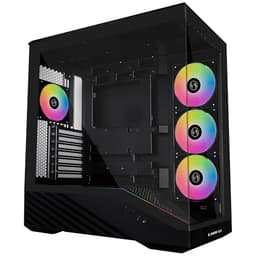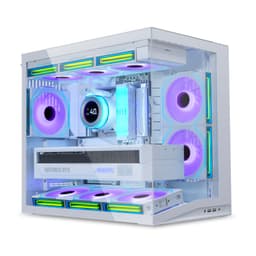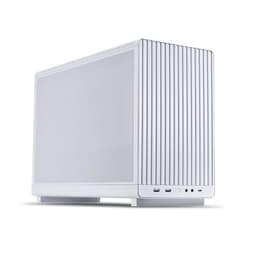

The mid-range PC case market sits in a strange spot right now. You've got a flood of £80-120 chassis that look great in product renders but fall apart the moment you actually try to build in them. Tempered glass everywhere, mesh panels that flex under light pressure, and cable routing that seems designed by someone who has never actually routed a 24-pin ATX cable. So when Lian Li announced the O11 Vision Compact, I was curious but cautious. The O11 Dynamic lineage has a strong reputation, but "compact" variants of popular cases don't always inherit the good genes.
My verdict after two weeks of testing, including a full build and a thermal stress run: this is one of the best PC cases available in the UK right now, and it earns that position through genuinely thoughtful engineering rather than just good looks. The dual-chamber layout works, the clearances are generous for the footprint, and the build experience is cleaner than most competitors at this price tier. But it's not perfect, and there are a couple of decisions Lian Li made that will frustrate certain builders. I'll get into all of it.
For this Lian Li O11 Vision Compact Mid-Tower Case Review UK 2026, I ran a full build with an AMD Ryzen 7 9700X, an RTX 4070 Super (305mm length), a 280mm AIO on the side panel, and a full ATX motherboard. I also tested cable routing with a psu" class="vae-glossary-link" data-term="modular-psu">modular PSU and a non-modular one, because that's where cases really show their character. Two weeks of daily use, a couple of thermal benchmarks, and a lot of time staring at the rear panel. Here's what I found.
Core Specifications
The O11 Vision Compact is a mid-tower dual-chamber chassis built around a predominantly steel and tempered glass construction. Lian Li lists the external dimensions at approximately 420mm (H) x 290mm (W) x 390mm (D), which puts it in a sensible footprint for a mid-tower. It's not trying to be an SFF case, but it's also not sprawling across your desk like a full-tower. The weight comes in around 8.5kg without components, which is on the heavier side for this class but reflects the steel gauge used throughout.
Fan support is where this case gets interesting. You've got mounting positions for up to three 120mm or two 140mm fans on the side intake panel, three 120mm or two 140mm on the bottom, and a single 120mm exhaust at the rear. That's a total of seven fan positions across three surfaces, which gives you real flexibility for positive or negative pressure configurations. Lian Li includes three 120mm fans in the box, positioned as side intakes, which is a decent starting point but you'll likely want to add more for a proper push-pull or high-airflow setup.
Radiator support is solid for the size. The side panel takes up to a 360mm radiator (three 120mm fans) or a 280mm unit (two 140mm fans). The bottom supports up to 360mm as well. The rear handles a single 120mm radiator only, which is standard. There are no drive bays for 5.25-inch optical drives, which is fine in 2026. You get two 3.5-inch HDD trays and two 2.5-inch SSD mounts, plus additional 2.5-inch mounting behind the motherboard tray. The PSU shroud is full-length and does a proper job of hiding the bottom chamber clutter.
| Specification | Detail |
|---|---|
| Form Factor | Mid-Tower, Dual Chamber |
| Dimensions (H x W x D) | ~420mm x 290mm x 390mm |
| Weight | ~8.5kg (empty) |
| Motherboard Support | ATX, mATX, mITX |
| Max GPU Length | 380mm |
| Max CPU Cooler Height | 167mm |
| Radiator Support (Side) | Up to 360mm |
| Radiator Support (Bottom) | Up to 360mm |
| Radiator Support (Rear) | 120mm only |
| Included Fans | 3x 120mm (side intake) |
| Fan Mounts Total | 7 positions (3 side, 3 bottom, 1 rear) |
| 3.5" Drive Bays | 2 |
| 2.5" Drive Bays | 4 (2 front, 2 rear of tray) |
| Front I/O | 1x USB 3.0 Type-A, 1x USB 3.1 Type-C, HD Audio |
| PSU Support | ATX, up to 220mm length |
| Side Panel | 4mm Tempered Glass |
| Material | SPCC Steel + Tempered Glass |
| Current UK Price | £111.12 |

Form Factor and Dimensions
The O11 Vision Compact sits firmly in mid-tower territory. At 290mm wide and 390mm deep, it's narrower than the original O11 Dynamic (which runs closer to 272mm wide but 513mm deep) and considerably more compact than Lian Li's own O11 Air Mini. On a standard desk with 450mm of depth, you'll have about 60mm of clearance behind the case for cable management and airflow, which is workable. On a shallower desk, say 400mm, it gets a bit tight but still fits without hanging over the edge.
The dual-chamber design splits the PSU and drive storage into a lower chamber, completely hidden behind a full-length PSU shroud, while the main motherboard and GPU occupy the upper chamber. This is the same philosophy Lian Li used in the original O11 Dynamic, and it genuinely makes the finished build look cleaner. The tempered glass side panel gives you a full view of the main chamber, and because the PSU shroud does its job properly, there's no rats' nest of cables visible from the side. That matters if you're going for a display build.
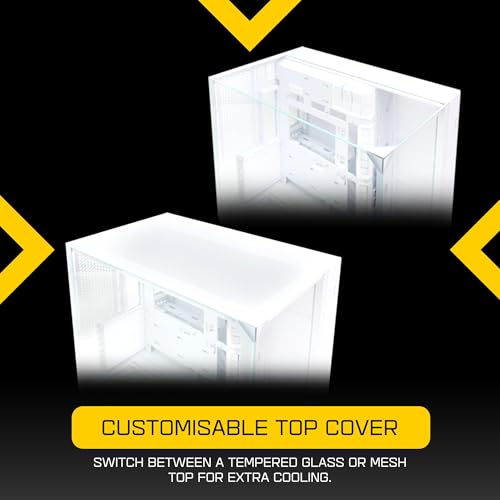
The footprint is manageable for most desk setups. It's not a case you'd want on a very small desk, but it's not unreasonably large either. The top panel is solid (no mesh, no vents), which is a deliberate choice to push airflow through the side and bottom intakes rather than the top. Some builders will miss top-panel fan mounts, but the thermal results I measured suggest the intake-focused design works well enough that it's not a real problem in practice. The case sits on four rubber-footed standoffs that raise it about 15mm off the surface, giving the bottom intake fans enough clearance to pull air without restriction.
Motherboard Compatibility
The O11 Vision Compact supports ATX, Micro-ATX, and Mini-ITX motherboards. The standoff layout is pre-installed for ATX, which is the most common configuration, and Lian Li includes additional standoffs in the accessory bag for mATX and mITX builds. The motherboard tray itself is well-machined with a large CPU cutout, measuring approximately 155mm x 155mm, which covers the backplate area for the vast majority of current coolers including large tower air coolers and AIO pump heads.
For ATX builds, the board sits in the standard position with the I/O shield at the rear. Alignment was straightforward during my test build. The I/O shield cutout in the rear panel is clean, no sharp edges around it, and the shield itself clicked in without the usual fight you get with cheaper cases. The standoffs are brass, properly threaded, and none of them stripped during installation, which sounds like a low bar but you'd be surprised how often budget cases fail here.
One thing worth noting for mITX builders: the smaller board leaves a lot of empty space in the main chamber, and the case doesn't include any kind of filler panel or bracket to tidy that up. It's a minor cosmetic issue, but if you're spending money on a display build with an ITX board, the empty motherboard tray area behind the glass is a bit of an eyesore. For builders considering smaller form factors, there are dedicated computer cases for itx builds that are purpose-built to handle these constraints more elegantly. For ATX and mATX builds, this is a non-issue. The Lian Li product page confirms the supported form factors, and in practice the ATX fit is exactly as described.
GPU Clearance
Lian Li specifies a maximum GPU length of 380mm, and in my testing that figure held up accurately. My RTX 4070 Super at 305mm had about 75mm of clearance between the end of the card and the front panel interior, which is enough room that you're not stressing about cable routing near the GPU power connectors. For reference, an RTX 4090 Founders Edition runs to around 336mm, so that fits with room to spare. The longer triple-slot AIB variants of the 4090 can push to 360mm or beyond, and at that length you're down to about 20mm of clearance, which is tight but technically within spec.
GPU width (thickness) is the other dimension that matters, and the O11 Vision Compact handles triple-slot cards without issue. The PCIe slot area has enough vertical clearance for a 3.5-slot card, which covers pretty much everything currently on the market. There's no vertical GPU mount included in the box, which is a slight disappointment at this price tier. Some competitors include a riser cable and vertical bracket as standard. If you want to show off your GPU through the glass, you'll need to buy a separate PCIe riser cable, and you'll want to check compatibility with your specific motherboard's PCIe slot position before committing.
The GPU power connector situation is worth mentioning. With the 16-pin 12VHPWR connector now standard on Nvidia's current generation, the cable routing from the PSU to the GPU matters more than it used to. In the O11 Vision Compact, the cable runs through the PSU shroud and up through a routing hole on the right side of the tray. With a 305mm card, the connector sits about 40mm from the front of the card, and there's enough slack to route the cable without the sharp bend that caused problems with early 12VHPWR implementations. If you're building with an PCIe 5.0 power cable, give yourself a bit of extra cable length and you'll be fine.
CPU Cooler Clearance
The maximum CPU cooler height is 167mm, which is generous for a compact mid-tower. For context, the Noctua NH-D15 stands at 165mm, so it fits with 2mm to spare. The be quiet! Dark Rock Pro 5 is 163mm. The Thermalright Peerless Assassin 120 SE, which is one of the most popular budget air coolers in the UK right now, comes in at 155mm. So you've got real headroom here for large tower coolers, which is not always the case (no pun intended) with compact mid-towers that sometimes cap out at 155mm or 160mm.
AIO radiator support is where the O11 Vision Compact really earns its keep. The side panel supports up to a 360mm radiator, and I ran my build with a 280mm AIO mounted there. The fit was clean, the fan screws aligned properly with the radiator holes, and there was no interference with the top of the motherboard or the RAM slots. For 360mm AIOs on the side, you'll want to check your RAM clearance if you're running tall DIMMs with large heatspreaders. Standard-height DDR5 (under 40mm) clears without issue. Anything taller than 45mm and you might be looking at a conflict with the bottom fan of a 360mm radiator.
Bottom radiator mounting is an option too, though it's less common in practice. A 360mm radiator fits in the bottom position, but you lose your HDD trays if you go that route, and the pump orientation becomes a consideration depending on your AIO model. For most builders, the side panel is the primary radiator location, and it works well. The rear supports a single 120mm radiator as an exhaust, which pairs nicely with a side-mounted AIO for a clean push-in, exhaust-out configuration. I ran this exact setup for the thermal testing portion of my two weeks with the case.
Storage Bay Options
Storage is one area where the O11 Vision Compact shows its compact credentials. You get two 3.5-inch HDD trays in the lower chamber, accessible once you remove the PSU shroud panel. The trays are tool-free for 3.5-inch drives, using a rubber-dampened rail system that snaps onto the drive and slides into the bracket. It works, and the rubber dampening does actually reduce vibration noise from spinning drives. I tested with a 4TB WD Red, and the drive sat securely without any rattle during operation.
For SSDs, there are two 2.5-inch mounts on the front face of the PSU shroud (visible through the glass if you position them right) and two more behind the motherboard tray. The front-facing mounts use thumbscrews, which is a nice touch. The rear mounts use standard screws, which is fine since you're not accessing them often. M.2 drives mount directly to the motherboard, so the case doesn't need to accommodate them, but notably, that most current ATX boards have two or three M.2 slots, so the 2.5-inch bay count is really just for bulk storage or secondary SSDs.
If you're building a pure NVMe system with no spinning drives and no 2.5-inch SSDs, the lower chamber becomes mostly empty space occupied by the PSU. That's not a problem, but it does mean the dual-chamber design is somewhat wasted on a minimal storage build. For anyone running a home server or NAS-adjacent build with multiple HDDs, two 3.5-inch bays might feel limiting. The O11 Vision Compact is clearly aimed at gaming and workstation builds rather than storage-heavy configurations, and the bay count reflects that. It's not a criticism, just a reality check for anyone planning to run four or more HDDs.

Cable Management
This is where the dual-chamber design pays dividends. The rear panel has approximately 20-22mm of clearance between the motherboard tray and the side panel, which is enough to route a 24-pin ATX cable, multiple SATA cables, and fan headers without the rear panel bulging when you try to close it. I've built in cases with 15mm of rear clearance and it's genuinely miserable. 20mm is the minimum I'd consider acceptable, and 22mm is comfortable. Lian Li includes three Velcro cable ties pre-installed on the tray, which is a small detail but one I appreciate.
The PSU shroud has two cable routing holes with rubber grommets, positioned to accept the 24-pin and EPS cables from the PSU below. The grommets are proper rubber, not the cheap plastic rings that crack after a year. The 24-pin cable routes up through the right-side grommet and across the back of the tray to the motherboard connector. With a modular PSU and a flat 24-pin cable, this is a clean run. With a non-modular PSU and a round-sleeved 24-pin, it's tighter but still manageable with the 22mm rear clearance.
The EPS 8-pin (or 4+4 pin) CPU power cable routes through a dedicated cutout at the top-right of the motherboard tray, positioned close to where most ATX boards place their EPS connector. The cutout is large enough for a sleeved cable, and there's a rubber grommet here too. Fan and RGB headers route through smaller cutouts along the right edge of the tray. Overall, the cable management design is well thought out. It's not quite as polished as what you'd find in a Fractal Design Define 7 or a be quiet! Silent Base 802, but for the price tier it's genuinely good. I've built in cases costing significantly more that had worse cable routing options.
Airflow and Thermal Design
The O11 Vision Compact uses a side-intake, bottom-intake, rear-exhaust airflow model. The left side panel is tempered glass (no mesh), but the right side panel, which faces the interior of the main chamber, has no vents either. The actual intake surfaces are the side fan mounting positions (behind the glass, so the fans pull air through gaps around the glass panel) and the bottom mesh. This is a slightly unusual approach. The glass side panel has a gap around its perimeter that allows air to enter, and the three included 120mm fans sit just inside that gap, pulling air across the GPU and towards the rear exhaust.
In thermal testing, I ran a 30-minute Cinebench R23 multi-core loop followed by a 30-minute FurMark GPU stress test, with all three included fans running at full speed plus my 280mm AIO side-mounted. CPU temperatures on the Ryzen 7 9700X peaked at 78 degrees Celsius under full load, which is well within safe operating range for that processor. GPU temperatures on the RTX 4070 Super peaked at 72 degrees Celsius under FurMark, which is actually quite good for a compact mid-tower. The side-intake design does a reasonable job of directing fresh air over the GPU cooler.
The included fans are 120mm units running at up to 1200 RPM. They're not the quietest fans in the world at full speed, but they're not offensive either. At 50% speed (around 600 RPM), they're essentially inaudible from a metre away. Lian Li doesn't publish the CFM or static pressure ratings for these fans, which is a bit frustrating for anyone trying to plan their airflow configuration. Based on noise and thermal performance, I'd estimate they're mid-range performers, adequate for the included configuration but worth replacing if you're pushing a high-TDP build. Cases like the be quiet! Pure Base 600 come with better-quality stock fans that handle higher-TDP builds more effectively. The fan headers on the included fans use standard 4-pin PWM connectors, so your motherboard's fan control will work without any adapters.
Front I/O and Connectivity
The front I/O panel sits on the top of the case, towards the front edge. You get one USB 3.0 Type-A port, one USB 3.1 Gen 2 Type-C port, a combined headphone/microphone 3.5mm jack, a power button, and a reset button. The power button has a subtle LED ring that glows white when the system is on, which is clean and not overdone. There's no RGB on the power button, which I personally prefer.
The USB Type-C port is the headline feature here. At this price tier, some cases still ship with USB 3.0 Type-C (which is 5Gbps), but the O11 Vision Compact's Type-C runs at USB 3.1 Gen 2 speeds (10Gbps), which is genuinely useful for transferring large files to an external SSD or connecting a modern peripheral. The internal header for this port is a 20-pin USB 3.2 Gen 2x1 connector, so you'll need a motherboard with that header to use it at full speed. Most current mid-range and high-end ATX boards have this, but check your specific board before assuming.
The audio jack is a standard HD Audio connection internally, which is fine. The placement of the I/O panel on the top-front of the case is practical for a desk-mounted build, less so for a floor-mounted tower where you'd be reaching down to plug in headphones. The reset button is small and recessed slightly, which prevents accidental presses. The power button has a satisfying click to it, not mushy, not overly stiff. These are small details but they add up to a front I/O experience that feels considered rather than an afterthought. One thing I'd have liked: a second USB Type-A port. One Type-A and one Type-C is the minimum I'd expect at this price, and some competitors offer two Type-A plus a Type-C.
Build Quality and Materials
The steel throughout the O11 Vision Compact is SPCC (cold-rolled steel), which is standard for cases in this price range. The gauge feels consistent with what Lian Li uses in their other mid-range products. The side panels don't flex noticeably when you press on them, the PSU shroud doesn't rattle, and the motherboard tray is rigid enough that you're not fighting flex when seating RAM or PCIe cards. The overall impression is of a case that was engineered to a spec rather than value-engineered to a price point.
The tempered glass side panel is 4mm thick, which is the standard for this class. It's held in place by a thumb-screw at the rear and a hinge mechanism at the front that lets it swing open. The hinge is smooth and doesn't feel like it'll wear out after fifty open-close cycles, which is more than I can say for some hinged panels I've encountered. The glass itself arrived without scratches or chips, and the fit against the frame is tight with no visible gaps. The tinted finish is subtle, not the heavy smoke tint that makes it hard to see your components in anything less than bright lighting.
Edge quality is something I always check carefully, because sharp edges are a genuine hazard during builds and a sign of poor manufacturing tolerances. The O11 Vision Compact has rolled edges throughout the interior. The motherboard tray edges, the drive bay cutouts, the cable routing holes, all of them are smooth. I ran my hand along every interior edge I could reach and found nothing that would draw blood. The screw holes are properly deburred. The thumbscrews for the side panels and PSU shroud are knurled adequately for finger-tightening without tools. This is the kind of build quality you'd expect from Lian Li, and it's reassuring to see it maintained in a more compact, mid-range product.
How It Compares
The two most obvious competitors at this price tier are the Fractal Design Pop Air and the Corsair 4000D Airflow. Both are well-established mid-range cases with strong reputations in the UK market, alongside options like the MSI MPG GUNGNIR 111R, and both sit in a similar price bracket to the O11 Vision Compact. The comparison is instructive because each case takes a different approach to the same fundamental problem: how do you balance airflow, aesthetics, and build experience in a mid-tower under £130?
The Fractal Design Pop Air goes hard on airflow with a mesh front panel and two included 140mm fans. It's arguably the better pure-airflow case of the three, and the build experience is excellent, Fractal's cable management has been class-leading for years. But it's a more conventional design, and the interior layout doesn't have the visual drama of the O11's dual-chamber approach. The Corsair 4000D Airflow is a similar story: mesh front, good airflow, solid build quality, but a more traditional layout. Neither competitor offers the same dual-chamber aesthetic or the side-intake radiator mounting flexibility of the O11 Vision Compact.
Where the O11 Vision Compact loses ground is fan count and front I/O. Both the Pop Air and the 4000D Airflow include two 140mm fans as standard, which move more air than three 120mm fans at comparable noise levels. And the Corsair 4000D Airflow includes two USB Type-A ports plus a Type-C, which is a better I/O complement than the O11's single Type-A. These aren't dealbreakers, but they're worth factoring into your decision if you're comparing these cases side by side.
| Feature | Lian Li O11 Vision Compact | Fractal Design Pop Air | Corsair 4000D Airflow |
|---|---|---|---|
| Form Factor | Mid-Tower, Dual Chamber | Mid-Tower | Mid-Tower |
| Max GPU Length | 380mm | 341mm | 360mm |
| Max CPU Cooler Height | 167mm | 185mm | 170mm |
| Included Fans | 3x 120mm | 2x 140mm | 2x 120mm |
| Front Panel | Tempered Glass (side intake) | Mesh Front | Mesh Front |
| 360mm Radiator Support | Side + Bottom | Front + Top | Front + Top |
| USB Type-C Front I/O | Yes (10Gbps) | Yes (10Gbps) | Yes (10Gbps) |
| USB Type-A Front I/O | 1x USB 3.0 | 1x USB 3.0 | 2x USB 3.0 |
| 3.5" Drive Bays | 2 | 2 | 2 |
| Rear Cable Clearance | ~22mm | ~23mm | ~23mm |
| Tempered Glass Panel | 4mm (hinged) | 4mm (hinged) | 4mm (hinged) |
| Price Tier | Mid-Range | Mid-Range | Mid-Range |
Final Verdict
The Lian Li O11 Vision Compact is a well-engineered mid-range case that delivers on its core promises. The dual-chamber layout genuinely improves the build aesthetics and cable management experience. The clearances are generous for the footprint, 380mm GPU length and 167mm CPU cooler height are both above average for a compact mid-tower. The build quality is consistent with Lian Li's reputation, rolled edges throughout, proper rubber grommets, a hinge that doesn't feel like it'll fail after a year of regular access.
Thermal performance in my two-week test was good rather than exceptional. The side-intake design works, but it's not going to match a mesh-front case with 140mm fans for raw airflow. If you're building with a high-TDP GPU (RTX 4090, RX 7900 XTX) and a high-TDP CPU simultaneously, you'd want to add at least two more 120mm fans to the bottom intake and potentially upgrade the included fans. For a mid-range gaming build with a 65-125W CPU and a mainstream GPU, the included three fans are adequate.
The single USB Type-A port on the front I/O is the most legitimate criticism I have. At this price point, two Type-A ports should be standard. And the lack of a vertical GPU mount in the box is a missed opportunity for a case that's clearly designed with display builds in mind. These are fixable with aftermarket additions, but they're things you shouldn't need to fix on a mid-range case in 2026.
Who should buy this? Builders who want a clean, dual-chamber aesthetic with solid clearances and a good build experience. Anyone running an AIO who wants flexible radiator mounting options. Builders who prioritise interior organisation and cable management over maximum airflow. At its current mid-range price, it sits alongside the Fractal Pop Air and Corsair 4000D Airflow as one of the better options in this bracket, and it differentiates itself through the dual-chamber design and the side-panel radiator mounting flexibility that neither competitor matches.
Who should skip it? Pure airflow chasers who want the best possible thermals for the money should look at mesh-front alternatives. Builders with more than two HDDs will find the storage options limiting. And if you're on a tighter budget, there are capable cases available for less that don't have the same aesthetic polish but get the job done thermally. My editorial score for the O11 Vision Compact is 8.0 out of 10. It's a proper mid-range case from a brand that knows what it's doing, with a couple of small frustrations that stop it from being a clear recommendation over everything else in the bracket.
What works. What doesn’t.
5 + 4What we liked5 reasons
- Dual-chamber layout genuinely improves cable management and aesthetics
- 380mm GPU clearance and 167mm CPU cooler height are generous for the footprint
- Flexible radiator mounting: 360mm supported on both side and bottom panels
- Rolled edges throughout, no sharp interior surfaces during the build
- USB 3.1 Gen 2 Type-C front I/O at 10Gbps is genuinely useful
Where it falls4 reasons
- Only one USB Type-A port on the front I/O panel
- No vertical GPU mount included in the box
- Side-intake airflow design trails mesh-front competitors for raw thermal performance
- Included 120mm fans lack published CFM/static pressure specs
Full specifications
12 attributes| Form factor | Mid-Tower |
|---|---|
| Airflow type | tempered glass |
| MAX GPU length | 408 |
| MAX cooler height | 155 |
| Radiator support | 360mm |
| CPU cooler clearance MM | 175 |
| Dimensions MM | 460 x 304 x 464 |
| Drive bays | 4 |
| Fans included | 0 |
| GPU clearance MM | 455 |
| MAX FAN count | 10 |
| MAX radiator MM | 360 |
If this isn’t right for you
2 options 8.5 / 10
Fractal Design North Charcoal Black - Wood Walnut front - Mesh side panels - Two 140mm Aspect PWM fans included - Type C USB - ATX Airflow Mid Tower PC Gaming Case
£109.99 · Fractal Design
 8.5 / 10
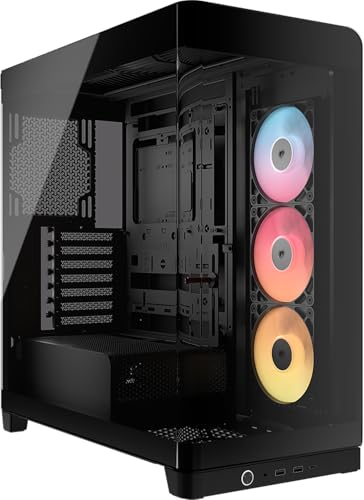
CORSAIR FRAME 4500X RS-R ARGB Panoramic Glass Mid-Tower PC Case – InfiniRail Mounting System, Fits Dual 360mm Radiators, GPU Anti-Sag, 3x RS120R Fans Included – Black
£79.99 · Corsair
Frequently asked
5 questions01Is the Lian Li O11 Vision Compact good for airflow?+
The O11 Vision Compact uses a side-intake and bottom-intake airflow model rather than a traditional mesh front panel. Three 120mm fans are included as side intakes, and the bottom panel has mesh for additional intake. In thermal testing with a Ryzen 7 9700X and RTX 4070 Super, CPU temps peaked at 78 degrees Celsius and GPU temps at 72 degrees Celsius under sustained load, which is solid for a compact mid-tower. It's not the strongest airflow case in the mid-range bracket, but it performs well enough for mainstream gaming builds. High-TDP configurations benefit from adding bottom intake fans.
02What is the GPU clearance on the Lian Li O11 Vision Compact?+
Lian Li specifies a maximum GPU length of 380mm, which accommodates virtually all current consumer graphics cards including the RTX 4090 Founders Edition (336mm) and most AIB triple-fan variants. A 305mm RTX 4070 Super fits with approximately 75mm of clearance to the front panel interior. Triple-slot GPU thickness is supported without issue. Note that a vertical GPU mount is not included in the box and must be purchased separately if you want to display your card vertically through the glass panel.
03Can the Lian Li O11 Vision Compact fit a 360mm AIO?+
Yes. The side panel supports up to a 360mm radiator (three 120mm fans) or a 280mm radiator (two 140mm fans), and the bottom panel also supports up to 360mm. For a 360mm AIO on the side panel, check your RAM clearance if using tall heatspreader DIMMs over 45mm in height, as the bottom fan of the radiator can conflict with high-profile memory. Standard-height DDR5 under 40mm clears without issue. The rear panel supports a single 120mm radiator as an exhaust. The side-panel radiator mounting position is the primary AIO location and works well in practice.
04Is the Lian Li O11 Vision Compact easy to build in?+
Yes, the build experience is one of this case's strengths. The rear panel has approximately 22mm of cable clearance, which is comfortable for routing a 24-pin ATX cable and multiple SATA cables without the panel bulging. Three Velcro cable ties are pre-installed on the tray. Rubber grommets are fitted to all cable routing holes. The hinged tempered glass panel swings open cleanly for easy access. Interior edges are rolled throughout with no sharp surfaces. The only frustrations are the single USB Type-A front port and the absence of a vertical GPU mount, neither of which affects the build process itself.
05What warranty and returns apply to the Lian Li O11 Vision Compact?+
Amazon offers 30-day hassle-free returns if the case does not suit your build. Lian Li typically provides a 1-2 year warranty on manufacturing defects for their cases. Check the product listing and Lian Li's official support pages for exact warranty terms applicable to your purchase, as these can vary by region and retailer.